Medicilon at SMR/BMCS 2026: Enabling Technologies for the Molecules That Matter
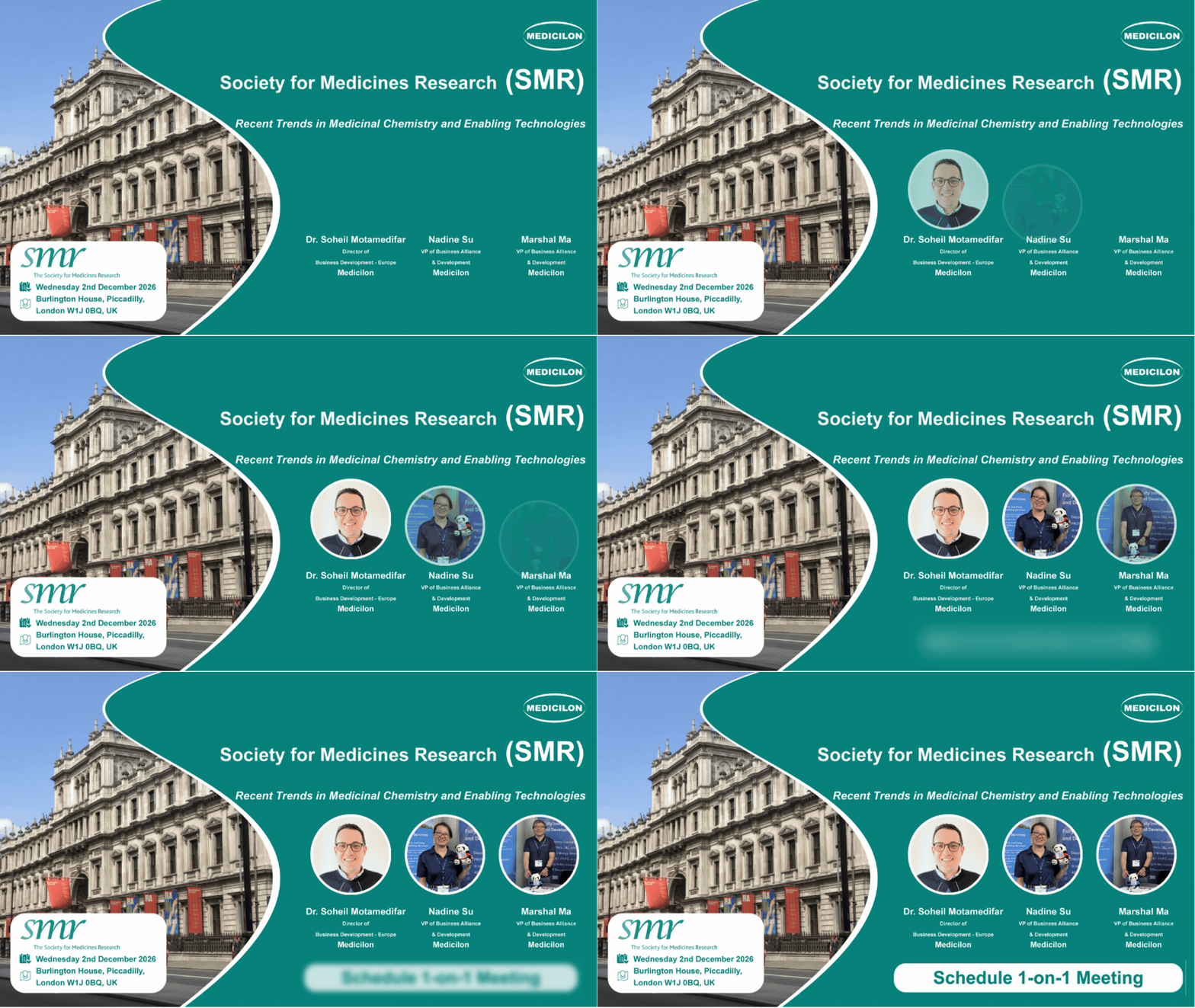
- Venue: Burlington House, Piccadilly, London W1J 0BQ, UK
- Date: Wednesday 2nd December 2026
London, 2 December 2026 – The Society for Medicines Research and the RSC Biological and Medicinal Chemistry Sector will convene at Burlington House for a one-day meeting on Recent Trends in Medicinal Chemistry and Enabling Technologies. The programme spans medicinal chemistry, drug discovery enabling technologies and chemical biology, with confirmed speakers from AstraZeneca, GSK, Domainex, Leiden University and others.
Medicilon will be represented by Dr. Soheil Motamedifar (Director of Business Development – Europe), Nadine Su (VP, Business Alliance & Development) and Marshal Ma (VP, Business Alliance & Development). The team will be available throughout the day to discuss how Medicilon’s integrated preclinical platforms translate emerging modality science into executable discovery programmes.
Where enabling technologies meet modality reality
The meeting’s focus on “enabling technologies” maps directly onto the questions discovery teams are asking: how to prosecute targets once considered undruggable; how to design conjugates and macrocycles with drug-like properties; how to compress the path from hit to IND-ready candidate. Medicilon’s platform build has followed that same logic.
Targeted protein degradation (PROTAC / molecular glue). Medicilon’s PROTAC platform covers high-affinity ligand design, customized linker synthesis, E3 ligase expertise and in vivo proof-of-concept studies, with dedicated capabilities for “undruggable” targets and degradation assay/PK-PD analysis. The company has supported multiple PROTAC programmes into clinical-stage development.
Macrocyclic peptides via mRNA display. The peptide discovery platform uses mRNA display libraries exceeding 10¹³ variants, supports natural and unnatural amino acid incorporation, and integrates cyclization chemistries with in silico design—a route to macrocycles with high affinity and protease stability for targets that resist small-molecule or antibody approaches.
ADCs and beyond. End-to-end ADC support runs from antibody discovery and linker-payload design through preclinical evaluation and regulatory documentation aligned with FDA and EMA expectations. The same conjugation and analytics infrastructure extends to antibody-oligonucleotide conjugates (AOCs) and peptide-drug conjugates.
AI-augmented discovery and new approach methodologies (NAMs). The MAIDD platform unifies small-molecule, nucleic acid and peptide design under an AI-assisted workflow. Separately, Medicilon has built NAMs capabilities for safety assessment, reflecting the broader shift toward human-relevant, mechanism-based toxicology in preclinical decision-making.
These capabilities sit within a preclinical infrastructure that has supported 700+ IND filings for more than 2,000 clients worldwide, under quality systems holding NMPA, FDA and OECD GLP certifications. For discovery teams evaluating external partners, the relevant question is not whether a platform exists in isolation, but whether chemistry, biology, DMPK and safety data connect into a coherent package. That integration is the operational core of Medicilon’s model.