On November 10, 2026, Medicilon and Ray Everest signed a strategic cooperation framework agreement on the “AI-Driven Upgrade of Automated Laboratory Production Lines for Life Sciences” in Shanghai. The two parties will work together to upgrade laboratory automation production lines across drug discovery and DMPK workflows, leveraging AI and automation technologies to improve unit throughput, per-capita efficiency, inter-batch consistency, and data traceability.
The ceremony was attended by Mr. Guokai Chen, Vice President of the Investment and Financing Development Department; Mr. Zhenxiang Zheng, Vice President of the General Management Department; and Dr. Pin Jiang, Vice President of the DMPK Department. Dr. Lei Wang, Founder, Chairman and CEO of Ray Everest, was joined by Mr. Qingbin Tan, General Manager of Shanke Venture Capital; Mr. Yi Zhang, Managing Partner of Huagai Capital; and Mr. Haifeng Pan, Partner of Tsing-Yuan Capital.
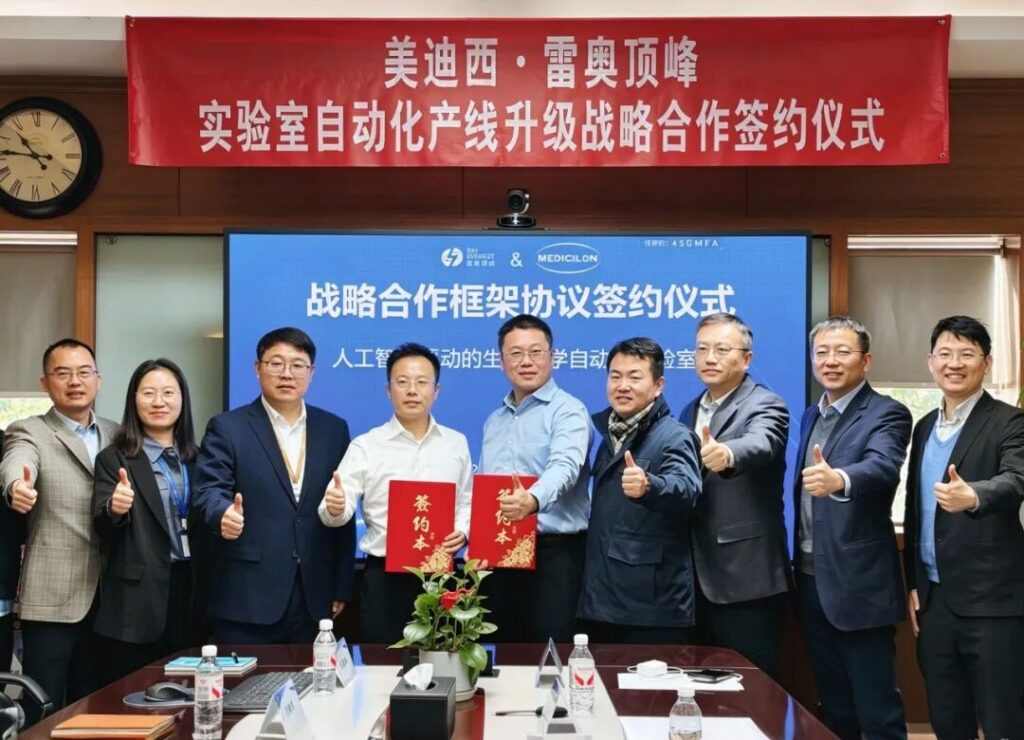
This partnership is not an ordinary equipment purchase. It is a production line level upgrade that Medicilon is advancing in its core wet-lab operations to embrace the AI-driven paradigm of drug R&D. From the solution design stage onward, the two parties jointly defined production line standards, conducting scenario assessment, prototype validation, and trial runs on the production lines actually in operation at Medicilon. Fifteen months passed between first contact and formal signing; across multiple scenarios covering every experimental operation on the line, tasks are progressively shifting from manual execution to coordinated execution by equipment and systems.
AI Is Rewriting Drug R&D — Medicilon Answers with a Dry-Wet Closed Loop
Dr. Pin Jiang noted that as early as 2008, Medicilon introduced its first batch of automated equipment and has iterated its automation capabilities ever since, while demand has kept growing. Medicilon has built an AI laboratory capability system spanning dry-lab prediction and wet-lab validation, forming a dry-wet integrated closed loop from computational prediction to experimental validation.
Mr. Guokai Chen noted that last year, the total value of China’s innovative drug License-out deals reached approximately USD 130 billion, and several blockbuster License-out pipelines were supported by preclinical R&D services from Medicilon, with corresponding cumulative deal value exceeding USD 10 billion. By the end of June 2026, Medicilon had served more than 2,000 clients worldwide; nearly 700 new drug projects it participated in have obtained IND clinical approvals, 50 of which have already reached commercial sale.
When orders arrive, capacity must be able to absorb them. The traditional path for CROs to expand capacity is to add headcount, whereas a production line level upgrade aims to gradually replace labor costs — which rise and fall easily — with depreciable, reusable fixed assets. This is what “production-line-level” concretely means: equipment renewal, workstation consolidation, process re-engineering, and software scheduling all moving forward together.
Dr. Pin Jiang stated that a partner must first support compliant assay scenarios and, second, genuinely understand the needs of both clients and CROs; only when both sides are on the same wavelength can projects advance efficiently. Imported platforms can be customized, but at long cycles and heavy cost what truly drives the choice is depth of understanding of the actual scenarios.
Co-Building the Line at Medicilon: From Defining Standards to Delivery and Acceptance
The first move was jointly defining production line standards. The partner was involved from the solution design stage; the two parties conducted assessments around real scenarios such as drug discovery and DMPK, and settled on solutions fit for commercial-scale capacity.
The second move was pushing requirements back upstream. The most authentic needs from the CRO front line flow directly back to the R&D side: which manual step is the most time-consuming, and which stage shows the largest inter batch variation.
The third move lies in combining AI with automation. Step one is connecting the automated delivery of sample plates, LC-MS analysis, and back-end report generation, enabling automated workstations to operate under unified commands; then, the experience of senior scientists is distilled into locally deployable models that keep self-correcting during operation. The first half of the dry-wet closed loop is AI prediction; the second half is wet-lab automation. The production-line upgrade is, in essence, paving a scalable data pathway for the second half.
Medicilon’s Selection Criteria: Scenario Fit and Production Line Capability
First, scenario fit takes priority over spec sheets. Drug discovery and DMPK both impose specific requirements on process linkage, sample flow, and inter-batch consistency. The partner must have a deep understanding of Medicilon’s real scenarios.
Second, data quality must be judged from the fundamental step of liquid handling: whether batches are more consistent, whether data is more traceable, and whether repeat experiments are fewer.
Third, the ability to run continuously is a hard threshold. A CRO operates at high frequency all year round with limited maintenance windows; equipment cannot merely perform well at acceptance testing. Medicilon looks at long term failure rates and maintenance response speed.
Fourth, the service radius affects downtime. For a CRO, service response is not an after-sales clause but part of capacity assurance. A partner located close to the R&D and service center is one of the factors Medicilon weighs when assessing long-term service support.
Medicilon’s AI Laboratory Roadmap: From Computing to Validating
The first layer is the comprehensive AI drug R&D technology platform (Medicilon Artificial Intelligence for Drug Discovery, MAIDD). Medicilon has connected multiple technology sub-platforms covering small molecules, nucleic acids, biologics, and peptides, spanning core capabilities such as protein structure prediction, intelligent molecular design, and AI-ADMET developability prediction. It has built a dry-wet integrated R&D closed loop of “computational prediction + experimental validation,” enabling the rapid optimization of new modalities such as PROTAC, XDC, and small nucleic acids across the full workflow from target discovery to candidate molecule screening.
The second layer is a compliant, scaled wet-lab validation system. Medicilon has proactively connected AI dry-lab prediction, in vitro NAMs model validation, and a GLP standardized wet-lab R&D system, building one stop preclinical service capability covering drug discovery, pharmaceutical research, preclinical research, and IND submission — allowing AI-generated candidate molecules to complete efficacy, pharmacokinetic, and safety validation in real experimental systems.
The third layer is the NAMs platform oriented toward next-generation evaluation methods. Medicilon is building a three-in-one NAMs service platform of “AI-driven + organoids + dry-wet integration,” combining human cell models, AI prediction, organoids, and PBPK modeling to improve human-relevance prediction while reducing reliance on traditional animal experiments — matching the need of AI-driven drug development for rapid early developability assessment.