
Therapeutic peptides are a rapidly expanding class of medicines, driven by the success of long-acting incretin therapies. However, natural peptides face limitations due to rapid degradation, kidney clearance, and short plasma half-lives. Traditional strategies involve chemical modification (e.g., lipid conjugation, cyclization, unnatural amino acids) or genetic engineering (e.g., Fc, albumin fusion proteins). While fusion proteins improve exposure, they are constrained by ribosomal translation, hindering the incorporation of unnatural amino acids, rigid cyclic peptide scaffolds, or non-peptidic linkers.
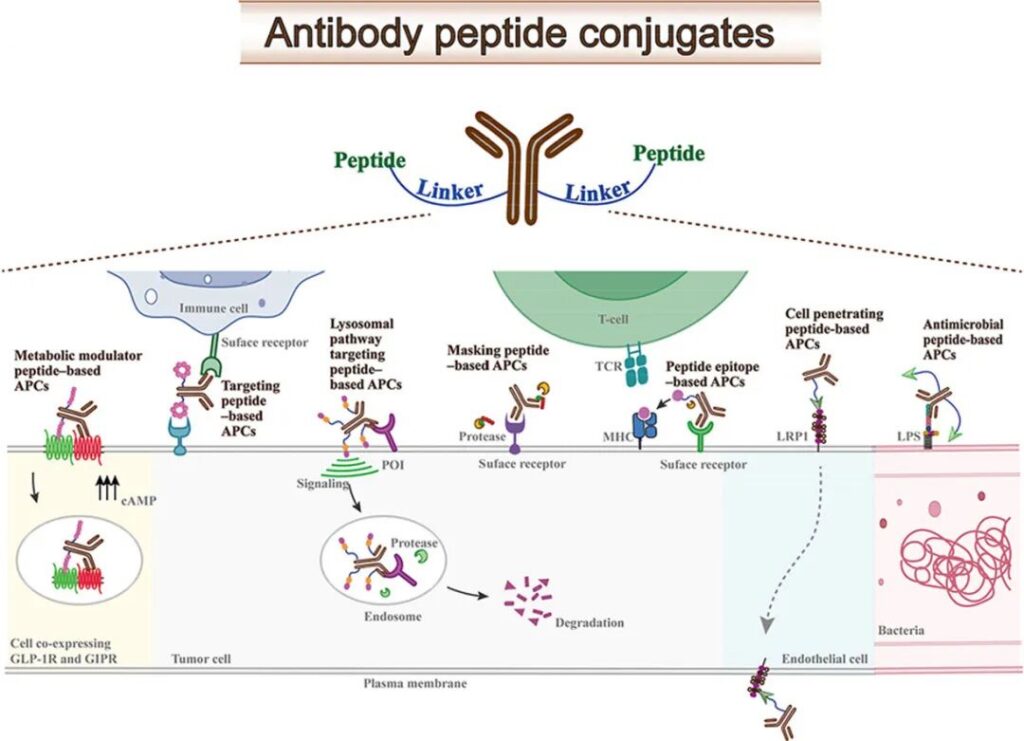
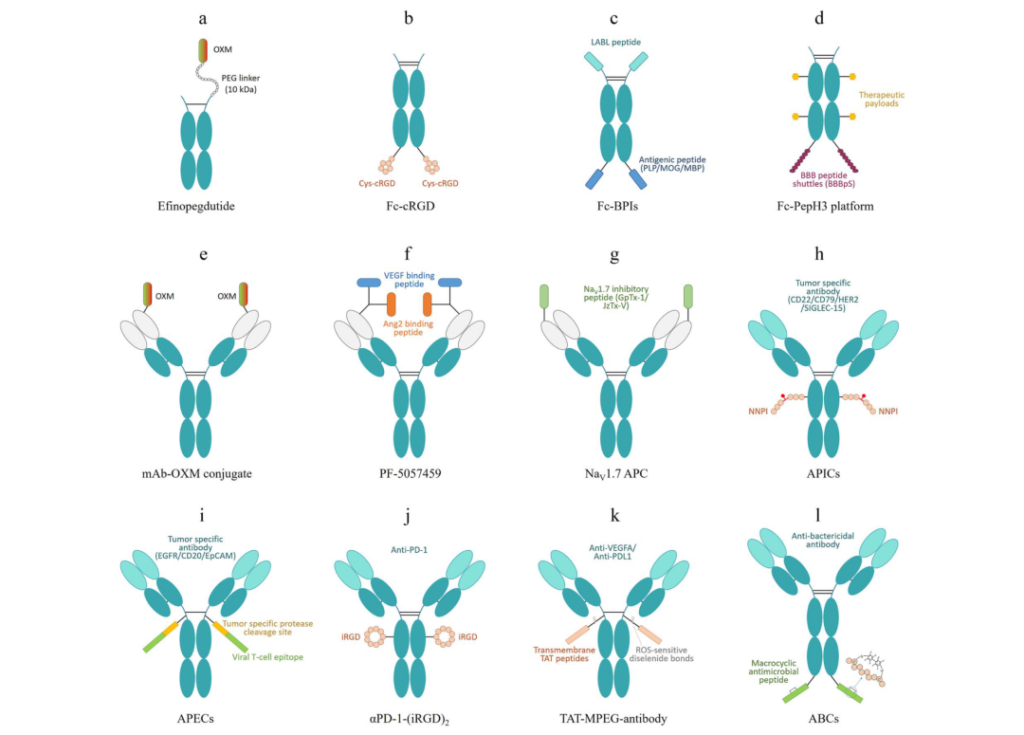
Antibody-peptide conjugates (APCs) covalently link monoclonal antibodies to chemically engineered peptides. This extends half-life, enables targeted delivery, and provides dual pharmacological activity. Unlike fusion proteins, APCs allow independent optimization of the antibody and peptide. Solid-phase peptide synthesis (SPPS) facilitates the flexible introduction of constrained cyclic structures, non-canonical amino acids, and custom linkers. This design is being applied across various therapeutic areas, including metabolic diseases, oncology, immunology, and rare diseases.
Medicilon Antibody Platform
Medicilon Peptide Platform
Core Capabilities of the APC
- Molecular design and feasibility assessment: Medicilon helps clients evaluate antibody-peptide compatibility, target combination strategies, linker design, conjugation site selection, and DAR control, providing recommendations based on developability analysis. The ADC platform contributes over 200 linkers and 30 payloads for APC project design and optimization.
- Peptide payload synthesis and optimization: Utilizing mRNA display and solid/liquid-phase synthesis, Medicilon screens and optimizes peptide sequences from diverse libraries through modifications like unnatural amino acid incorporation, cyclization, and fatty acid or PEG conjugation.
- Antibody preparation and engineering: Services include antibody discovery, recombinant expression and purification, and quality attribute control, with experience in high-expression cell line construction.
- Site-specific conjugation process: Medicilon employs various conjugation chemistries, including Click chemistry (DBCO-azide), maleimide-thiol, enzymatic conjugation (e.g., mTGase), and site-specific conjugation via antibody site mutation. Flexible process selection and precise DAR control are achieved through methods like TCEP reduction and quantitative addition, coupled with AEX for efficient purification.
- Analytical characterization: The platform is equipped with AEX, SEC, UPLC-MS, and TOF-MS for conjugate purification, DAR distribution analysis, molecular weight confirmation, and impurity characterization, with routine tests including HPLC/UPLC, LC-MS, CE-SDS, SEC, IEC, and peptide mapping.
- In vitro/in vivo pharmacology and PK/PD evaluation: Medicilon’s pharmacology department has established over 1,100 efficacy models, including more than 800 oncology models (xenograft, orthotopic, syngeneic, transgenic, humanized, PDXO/PDX organoid, and standard-of-care resistant) and approximately 300 non-oncology models covering inflammation, autoimmune, neurological, metabolic, cardiovascular, and digestive system diseases. Large animal models (non-human primates, dogs, rabbits, minipigs) are also available for standard and customized disease development. For PK/PD, the platform offers systematic analytical and evaluation methods for biotherapeutics like peptides, monoclonal antibodies, and conjugated drugs, encompassing in vitro/in vivo PK, DMPK, and large animal biopsy platforms.
- Preclinical safety and IND filing: With NMPA GLP accreditation, Medicilon provides pharmacokinetic and safety evaluations compliant with NMPA, FDA, and other international GLP standards, supporting IND dossier preparation and regulatory strategy consulting.
Medicilon’s Deep Engagement in Early-Stage APC R&D
Summary
Reference:
- [1] Fei Xie, et al. Antibody peptide conjugates as multifunctional therapeutics: Mechanisms, challenges, and prospects. Acta Pharmaceutica Sinica B. 3 August 2026
- [2] Junming Yie, et al. Design and therapeutic rationale of antibody-peptide conjugates: insights from maridebart cafraglutide (AMG133) and emerging applications. Antib Ther. 2026 Jun 1;9(3):367-380. doi: 10.1093/abt/tbag029. eCollection 2026 Jul.