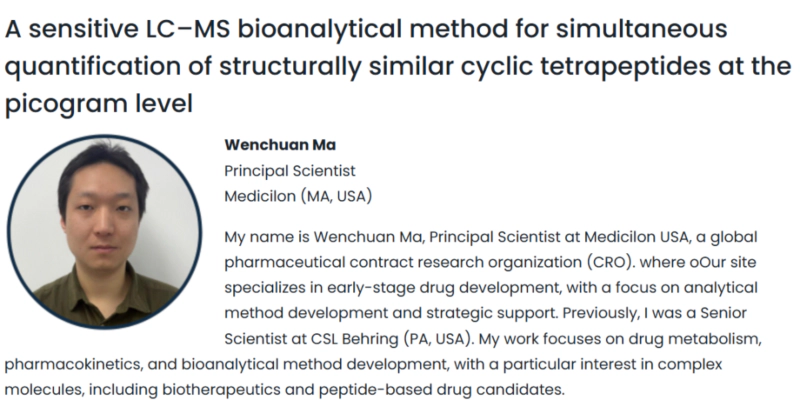
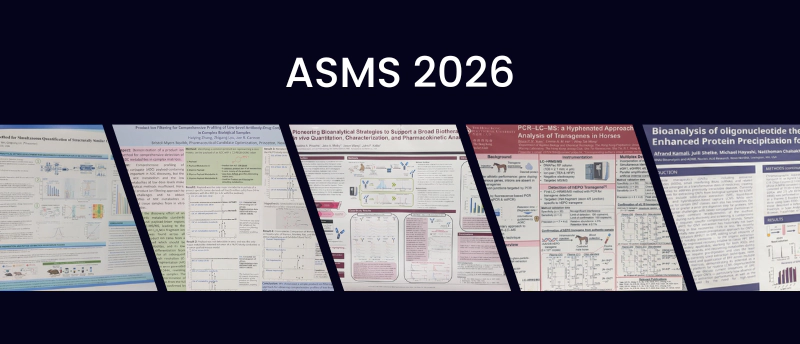
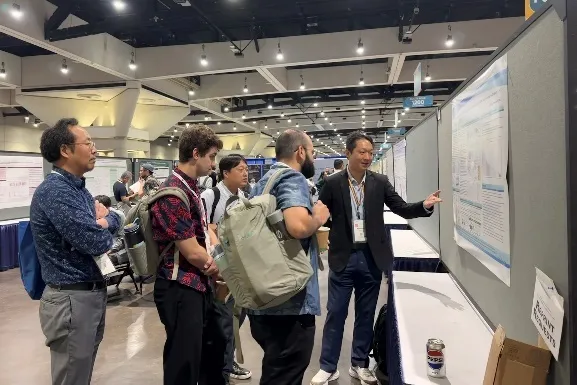
The 74th ASMS Annual Conference on Mass Spectrometry and Allied Topics, held in San Diego from 31 May to 4 June 2026, drew thousands of leading experts from across the global mass spectrometry community. Among the ~3,000 posters presented, Bioanalysis Zone – a premier independent media platform in bioanalytical science – selected just fivefor its exclusive “Pick of the Posters” feature. We are delighted to announce that Medicilon’s contribution, presented by Dr. Wenchuan Ma (Principal Scientist, Medicilon USA, Lexington, MA), was one of the five honored posters.
Notably, Medicilon is the only CRO to receive this distinction, standing alongside poster authors from Novo Nordisk, AstraZeneca, Bristol-Myers Squibb, and leading academic institutions. This recognition affirms that Chinese CROs have achieved globally competitive capabilities in advanced bioanalytical technologies.

The Challenge: Quantifying 40 Structurally Similar Cyclic Tetrapeptides at Picogram Levels
The selected poster addresses a formidable analytical hurdle encountered in a cyclic peptide drug discovery program. The project involves a recombinant protein scaffold that, upon in vivo enzymatic cleavage, releases up to 40 structurally similar cyclic tetrapeptides – the smallest cyclic peptide framework that retains sequence-dependent physicochemical properties while gaining conformational rigidity. Reliable quantification of these analytes in complex biological matrices such as rat plasma at picogram-per-microlitre levels poses extreme difficulties:
- Ultra-low concentration: in vivo exposure levels approach the sensitivity limit of electrospray ionisation (ESI), typically picogram-level injection amounts.
- High structural similarity: Many positional isomers co-elute under standard reversed-phase gradients, with retention-time differences as small as ΔRT < 0.3 min, making mass-to-charge (m/z) ratio alone insufficient for discrimination.
- Isobaric interference: Some pairs, such as PAPP and PPHP, share the identical nominal [M+H]⁺ m/z of 423.2, making Q1-based discrimination impossible without additional selectivity.
Four Innovative Strategies to Redefine Cyclic Peptide Bioanalysis
To meet these challenges, the team developed a highly integrated LC‑MS/MS workflow -built on a SCIEX 6500+ triple quadrupole coupled with nanoflow UHPLC – that goes far beyond conventional small‑molecule bioanalysis by combining hardware, acquisition modes, and mobile‑phase chemistry in a multi‑dimensional approach that incorporates several innovative elements.
Nanoflow LC Achieves 50-100× Sensitivity Gain
By reducing the flow rate to 5 μL/min (nanoflow UHPLC), the team dramatically improved ESI efficiency – yielding a 50- to 100-fold increase in ionisation performance compared with conventional flow rates. This pushed the lower limit of quantification (LLOQ) down to 0.05-0.1 pg/μL, providing a solid foundation for reliable detection at physiologically relevant concentrations.
Q1 Primary Quantification with Targeted MS/MS Confirmation
Cyclic peptides fragment unpredictably because the ring must open before sequence-specific fragmentation can occur. Recognising the inefficiency of conventional MRM, the team adopted Q1 precursor ion full-scan as the primary quantitative channel – which consistently delivered far higher signal intensity than MRM. MS/MS (with stepped collision energy 25-50 eV) was reserved exclusively for confirming isobaric and co-eluting pairs (e.g., PAPP/PPHP) using diagnostic b/y product ions. This hybrid approach preserves sensitivity while ensuring unambiguous specificity.
pH-Controlled Charge-State and Ion-Suppression Management
The team observed that for peptides containing histidine or arginine residues, the equilibrium between [M+H]⁺ and [M+2H]²⁺ charge states is highly sensitive to mobile-phase pH. By finely tuning the concentration of formic acid modifier, they successfully consolidated the signal into a single dominant charge state, preventing sensitivity loss due to signal splitting. At the same time, this optimisation minimised ion suppression from residual salt adducts, consistently keeping matrix effects within the FDA-recommended 15% threshold across all tested matrices.
0.05min Retention-Time Gating for Orthogonal Selectivity
Full chromatographic resolution of all 40 analytes is impractical. Instead, gradient optimization focused specifically on those pairs indistinguishable by m/z. A strict retention-time tolerance window of ±0.05 min served as a second orthogonal dimension of selectivity, complementing mass-based discrimination without sacrificing sensitivity.
Data-Driven Validation and in vivo Biotransformation Insights
❖ Matrix versatility: The method was successfully validated across five distinct biological matrices: rat plasma, liver homogenate, kidney homogenate, brain homogenate, and urine. Consistent performance was demonstrated in all matrices, with ion suppression maintained within regulatory limits.
❖ In vivo application: When applied to plasma samples from rats subcutaneously administered with the parent protein, the method reliably quantified approximately 36 of the 40 target cyclic tetrapeptides. Importantly, the ranked abundance profiles generated from these data provided direct insight into the proteolytic cleavage preferences of the parent substrate in vivo. This information offers actionable guidance for rational redesign of the protein scaffold and for identifying candidate pharmacodynamic biomarkers.
A Strong Endorsement of Medicilon Expertise
As Dr. Wenchuan Ma emphasized in his poster discussion: “Sensitivity, charge-state distribution, selectivity, and detection strategy must all be considered together. For cyclic peptides, abandoning the small-molecule mindset and adopting a holistic, multi-dimensional approach is the key to success.”
This selection by Bioanalysis Zone is not only a testament to the deep mass spectrometry expertise within Medicilon’s DMPK & Bioanalysis team, but also a clear demonstration of Medicilon’s growing leadership in bioanalysis for complex modalities – including peptides, cyclic peptides, and beyond. As the only CRO recognized in this elite selection, Medicilon has proven that its capabilities are on par with top-tier in-house pharma laboratories.